1. Introduction
The tropics harbour an extraordinary mosaic of forested landscapes — from the dense, multi-storeyed Amazon and Congo Basin rainforests to the deciduous monsoon forests of South and Southeast Asia. These ecosystems do not merely represent repositories of timber; they are functional pillars of the global carbon cycle, watersheds, and indigenous livelihoods. Despite their ecological grandeur, tropical forests have experienced relentless pressure from agricultural expansion, illegal logging, fire, and urban encroachment.
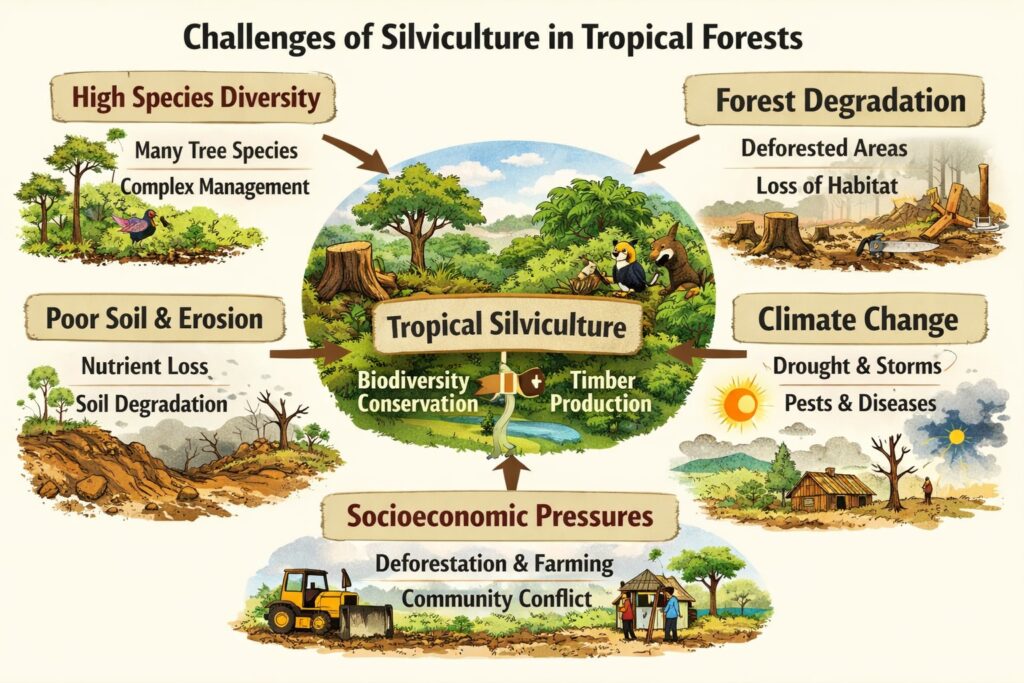
Silviculture — the science and practice of controlling the establishment, growth, composition, and quality of forest stands — offers a pathway to reconcile timber production with conservation objectives. However, the application of silvicultural principles developed largely in temperate contexts to the far more complex architecture of tropical forests has proven deeply problematic. The sheer ecological diversity, socio-political fragmentation, and climatic volatility of tropical regions create a constellation of challenges that demand both scientific rigour and pragmatic ingenuity.
| “Managing a tropical forest without understanding its ecology is like performing surgery without anatomy — technically possible, but extraordinarily risky.” |
Principal Challenge Categories
| Biological Complexity Extreme species richness, unknown regeneration niches, and complex plant-animal interactions. | Climate Variability ENSO-driven droughts, intensified rainfall, and shifting phenological windows. |
| Socio-Economic Pressure Poverty, land tenure insecurity, and commodity-driven deforestation frontiers. | Governance Gaps Weak institutions, corruption, and limited scientific capacity in forest agencies. |
2. Ecological Challenges
2.1 Extraordinary Species Richness
One hectare of Amazonian forest may contain more than 300 tree species, compared to fewer than 30 in a temperate European stand. This hyper-diversity renders species-specific silvicultural prescriptions logistically and economically unworkable at scale. The growth rates, shade tolerance, seed dispersal mechanisms, and competitive dynamics of most tropical tree species remain poorly quantified. Management decisions must therefore be made under profound uncertainty.
Dipterocarp forests of Southeast Asia, for example, exhibit mast fruiting events — synchronised, supra-annual seed production events — that create narrow and unpredictable regeneration windows. Missing a masting season through poorly timed harvesting can eliminate recruitment opportunities for an entire decade. Similarly, many timber species depend on specialist animal vectors for both pollination and seed dispersal; disruption of these mutualistic networks through hunting or habitat fragmentation can silently collapse natural regeneration.
2.2 Structural and Successional Complexity
Tropical forests are vertically stratified into emergent, canopy, sub-canopy, understorey, and ground layers, each with distinct microclimatic conditions and species assemblages. Unlike even-aged temperate plantations, uneven-aged tropical systems require selection systems that must be adapted to stand-specific structural conditions.
| Key Silvicultural Systems Used in Tropical Forests Selective Logging Systems — harvest only designated diameter classes, retaining understoreyReduced Impact Logging (RIL) — directional felling, pre-harvest planning to minimise residual damageClear-felling with Enrichment Planting — artificial regeneration of degraded areas with native speciesCoppice Systems — utilised in dry tropical forests for fuelwood and charcoal productionTaungya and Agroforestry — integration of food crops with timber trees in early plantation stages |
2.3 Soil Sensitivity and Nutrient Cycling
Contrary to popular assumption, the lush productivity of tropical forests is not a product of fertile soils. Most tropical soils — notably the Oxisols and Ultisols that dominate the humid tropics — are ancient, heavily weathered, and nutrient-poor. The apparent fertility of tropical forests is locked in biomass and sustained through tight, rapid nutrient cycling. When that biomass is removed through logging, nutrient capital is exported with the timber, leaving behind degraded substrates vulnerable to compaction, erosion, and weed invasion.
3. Climatic and Environmental Challenges
3.1 Climate Change and Increased Disturbance
The Intergovernmental Panel on Climate Change (IPCC) projects that tropical regions will experience increased frequency and severity of extreme rainfall events, prolonged dry seasons, and elevated temperatures. These changes have direct consequences for silvicultural practice. Elevated temperatures accelerate decomposition of soil organic matter, reducing site fertility. Extended dry seasons increase fire risk, particularly in logged-over forests where accumulated slash provides a combustible fuel load.
The 1997-1998 El Nino event triggered widespread fires across Borneo and Sumatra that burned an estimated 9.7 million hectares of forest, including many certified timber concessions practising supposedly sustainable management. Events of this magnitude raise fundamental questions about whether any form of intensive silviculture can remain viable in a climate-altered future without radical modifications to risk management.
Estimated Annual Tropical Forest Loss (Selected Regions, 2020-2023)
| Region | Approx. Annual Loss |
| Brazilian Amazon | ~11,600 km²/yr |
| Congo Basin | ~6,500 km²/yr |
| Southeast Asia | ~5,700 km²/yr |
| South/Central America (excl. Brazil) | ~3,600 km²/yr |
Sources: Global Forest Watch, Hansen et al. estimates. Values approximate.
3.2 The Carbon-Timber Tension
Increasing international pressure to maintain standing tropical forests as carbon sinks has created a tension with productive forestry. Mechanisms such as REDD+ (Reducing Emissions from Deforestation and Forest Degradation) offer payments for avoided deforestation, but their interaction with legal timber harvesting remains contested. In many cases, the opportunity cost of foregoing timber revenues exceeds REDD+ compensation, particularly for governments facing significant fiscal pressures.
4. Socio-Economic and Institutional Challenges
4.1 Land Tenure and Forest Governance
Secure, well-defined, and equitably enforced land tenure is a prerequisite for sustainable silviculture. Yet across much of the tropical world, overlapping claims between state, customary, and corporate interests create contested landscapes where no actor has sufficient security to invest in long-rotation forestry. A timber concessionaire uncertain about whether a concession will be renewed in ten years has every incentive to maximise short-term extraction rather than invest in silvicultural treatments whose benefits accrue over decades.
Community forestry programmes in Nepal, Mexico, and parts of West Africa have demonstrated that local communities with secure tenure often manage forests more sustainably than state agencies. However, scaling these models has proven difficult due to bureaucratic resistance, elite capture of forest benefits, and the challenges of aggregating individual incentives across large landscapes.
4.2 Economic Viability of Sustainable Practices
Reduced Impact Logging (RIL), enrichment planting, silvicultural thinning, and post-harvest monitoring all require significant up-front investment. In competitive global timber markets, certified sustainably harvested tropical timber struggles to command a sufficient price premium to cover these additional costs. The economic case for sustainable silviculture remains fragile and context-dependent, often relying on a combination of certification premiums, carbon payments, and regulatory compliance rather than market forces alone.
| “Sustainable tropical silviculture will not emerge from ecological knowledge alone. It requires economic architectures that reward the stewardship of complexity over its simplification.” |
4.3 Scientific Capacity and Knowledge Gaps
Many tropical countries with the greatest forest endowments face significant constraints in forestry research institutions, university training, and monitoring infrastructure. Growth and yield models — the mathematical backbone of silvicultural planning in temperate systems — are available for only a small fraction of tropical species. Remote sensing and LiDAR technologies are beginning to fill structural data gaps, but ground-truthing remains labour-intensive and chronically underfunded.
5. Emerging Approaches and Pathways Forward
5.1 Adaptive Silviculture and Flexible Management
Given the complexity and uncertainty inherent in tropical forest management, rigid silvicultural prescriptions are likely to fail. Adaptive management frameworks — which treat management interventions as experiments, incorporate monitoring feedback into revised prescriptions, and maintain flexibility across variable ecological and climatic conditions — offer a more robust paradigm. This requires institutional cultures that reward learning from failure rather than penalising deviation from predetermined plans.
5.2 Integrating Indigenous and Local Knowledge
Indigenous peoples and local communities have developed sophisticated ecological knowledge of tropical forests over generations. This knowledge — encompassing phenological calendars, species relationships, and disturbance patterns — can complement formal silvicultural science in ways that improve management outcomes and build social legitimacy. Co-management approaches that genuinely integrate this knowledge, rather than merely tokenising it, have shown promising results in settings as diverse as the Brazilian Amazon, Papua New Guinea, and the Indian Western Ghats.
5.3 Restoration Silviculture
Given the scale of tropical forest degradation, restoration has become as important a silvicultural challenge as production management. The restoration of structurally complex, species-rich forests from degraded land is technically demanding and expensive. However, innovations such as the Framework Species Method, analog forestry, and assisted natural regeneration are demonstrating that high-biodiversity forest recovery can be accelerated without resorting to monoculture plantations.
| Priorities for Advancing Tropical Silviculture Expand species-level growth and yield databases for tropical timber and non-timber speciesInvest in long-term permanent sample plots across key biomes (Amazon, Congo, Southeast Asia)Reform forest concession systems to incentivise long-rotation and multi-product managementDevelop climate-smart silvicultural guidelines that account for increased disturbance regimesMainstream community tenure rights and co-management agreements at national policy levelsAlign REDD+ mechanisms with productive sustainable forestry rather than treating them as alternatives |
6. Conclusion
Tropical silviculture operates at the intersection of ecology, economics, politics, and culture. Its challenges are not simply technical — they are civilisational. The question of whether humanity can sustainably manage the world’s tropical forests is, at its core, a question about whether we can build institutions, markets, and value systems that reflect the long-term complexity of living systems rather than the short-term logic of commodity extraction.
There is reason for cautious optimism. The scientific tools for more ecologically grounded silviculture are advancing rapidly. Community-based approaches have demonstrated that local actors, given rights and recognition, can be powerful agents of forest stewardship. Climate finance mechanisms are beginning to provide economic signals that, however imperfectly, revalue standing forests. The challenge now is integration — weaving these advances into coherent, place-based management systems capable of functioning within real-world political economies.
The forest, in its staggering complexity, does not demand perfection from its managers. It demands attention, humility, and the willingness to keep learning.
Selected References
Ashton, P.S. (2014). On the Forests of Tropical Asia: Lest the Memory Fade. Kew Publishing.
Chazdon, R.L. (2014). Second Growth: The Promise of Tropical Forest Regeneration in an Age of Deforestation. University of Chicago Press.
Denslow, J.S. & Guzman, G.S. (2000). Resistance of a native forest understory to invasion by Piper aduncum. Biological Invasions, 2(4), 201-209.
IPCC (2022). Climate Change 2022: Impacts, Adaptation and Vulnerability. Contribution of WG II to the Sixth Assessment Report.
Putz, F.E. et al. (2012). Sustaining conservation values in selectively logged tropical forests. Ecology and Society, 17(1), 17.
Sheil, D. & Murdiyarso, D. (2009). How forests attract rain: an examination of a new hypothesis. BioScience, 59(4), 341-347.
Whitmore, T.C. (1998). An Introduction to Tropical Rain Forests (2nd ed.). Oxford University Press.